Locksley Resources (LKY:AU) has announced Locksley Paves Pathway to 100% Made in America Antimony
Download the PDF here.
This post appeared first on investingnews.com
Locksley Resources (LKY:AU) has announced Locksley Paves Pathway to 100% Made in America Antimony
Download the PDF here.

Brightstar Resources (BTR:AU) has announced Mining Approvals Received for Lord Byron Open Pit Mine
Download the PDF here.

Highlights
– Excellent metallurgical recoveries ranging between 82.9% and 85.9%, validating that the Mojave project can deliver the feedstock required to underpin a domestic mine-to-market antimony supply chain
– Recovery rates of this level confirm Locksley’s pathway to 100% Made in America Antimony, directly aligned with U.S. government priorities for onshore critical mineral supply security
– Options to use concentrate in a pilot test to produce antimony metal ingot, antimony oxide and antimony trisulphide being assessed –
– Composite sample collected from surface is expected to have undergone some level of oxidation. Antimony recoveries expected to improve further with fresh rock samples (to be collected from drilling) as level of Antimony mineral oxidation expected to be reduced
– Assayed head grade of composite sample of 9.6% Antimony, compared to calculated head grade from each test completed ranging from 10.0% Sb to 11.1%
– High-grade initial rougher concentrate of 59.6% Antimony (R04- stage 1) indicates antimony minerals liberate naturally from the initial grind, with rougher concentrate regrinding and cleaning expected to achieve a high-grade concentrate at high Antimony recovery
– Final rougher peak concentrate grade achieved of 39.1% Antimony (R02-stage 1-5), with 5 tests exceeding 35.1% Antimony and 1 test achieving 27.5% Antimony
– Concentrate sent to Rice University to commence with Dep Eutectic Solvent extraction testwork using DeepSolv(TM) methodology
– Upon completion of the testwork, high quality Antimony concentrate samples will be delivered to Rice University for commencement of Thrust 1 extraction and production of antimony metal using DeepSolv(TM) technology, further advancing Lockksley’s role in securing domestic U.S. critical minerals supply chain
Metallurgical Testwork Program
Locksley engaged specialist metallurgical consultants SGS Australia owned Independent Metallurgical Operations Pty Ltd (IMO) to oversee an initial metallurgical testwork program on a 23.1kg composite sample grading 9.6% antimony (‘Sb’), collected from surface stocks at DAM (Figure 1). The composite sample was delivered to Base Metallurgical Laboratories located in Tucson Arizona for the planed testwork.
A standard flowsheet was devised by IMO to undertake a series of six flotation tests using a variety of reagents and initial rougher stage flotation steps, conditioning time and grind sizes. The results from each of the tests are shown on Table 1.
In all tests, the flotation proved effective in recovery of Stibnite (the antimony hosting mineral) from the composite sample and importantly produced a concentrate exceeding 30% Sb in 5 out of the 6 tests completed. Furthermore, initial stage 1 steps delivered a high grade concentrate up to 59.6% Sb (R04-stage 1), indicating that the antimony minerals liberate naturally from the initial grind, with rougher concentrate regrinding and cleaning expected to achieve a high-grade concentrate at high Sb recovery. This is significant as the testwork has demonstrated the potential to produce a high grade concentrate which could meet required specifications as feedstock material for conventional pyrometallurgical process.
Further testwork is ongoing with the objective of improving stibnite recovery and concentrate grade. It is anticipated that this will be achieved with subsequent regrind and cleaning stages with the goal of targeting a final concentrate grade of >50% Sb (note pure stibnite has a theoretical grade of 71.68% Sb).
Next Steps
Metallurgical testwork is ongoing and the following activities are planned or underway:
1. Further regrind and cleaning testwork to determine overall recovery and concentrate grade
2. Mineralogical testwork on the head, concentrate and tail to determine stibnite deportment to develop an understanding of the ore characteristics
3. Provide a sample of concentrate to Rice University to commence with Dep Eutectic Solvent extraction testwork using DeepSolv(TM) methodology
4. Investigate options to use the concentrate in a pilot test to produce antimony metal ingot, antimony oxide and antimony trisulphide
Julian Woodcock, Technical Director of Locksley Resources, commented:
‘This is an excellent milestone to have achieved for the Mojave Project, which demonstrates that conventional flotation technology is suitable to produce a stibnite concentrate from the Desert Antimony Mine Prospect. What is also remarkable is the success of the testwork on surface samples, which have been susceptible to oxidation. I am extremely encouraged by the results and optimistic that with further testwork we will be able to improve on this already high-quality first-pass outcome. This activity continues to rapidly advance our strategy to provide onshore supply of antimony to the U.S. market.’
*To view tables and figures, please visit:
https://abnnewswire.net/lnk/19N2O557
About Locksley Resources Limited:
Locksley Resources Limited (ASX:LKY,OTC:LKYRF) (FRA:X5L) (OTCMKTS:LKYRF) is an ASX listed explorer focused on critical minerals in the United States of America. The Company is actively advancing exploration across two key assets: the Mojave Project in California, targeting rare earth elements (REEs) and antimony. Locksley Resources aims to generate shareholder value through strategic exploration, discovery and development in this highly prospective mineral region.
Mojave Project
Located in the Mojave Desert, California, the Mojave Project comprises over 250 claims across two contiguous prospect areas, namely, the North Block/Northeast Block and the El Campo Prospect. The North Block directly abuts claims held by MP Materials, while El Campo lies along strike of the Mountain Pass Mine and is enveloped by MP Materials’ claims, highlighting the strong geological continuity and exploration potential of the project area.
In addition to rare earths, the Mojave Project hosts the historic ‘Desert Antimony Mine’, which last operated in 1937. Despite the United States currently having no domestic antimony production, demand for the metal remains high due to its essential role in defense systems, semiconductors, and metal alloys. With significant surface sample results, the Desert Mine prospect represents one of the highest-grade known antimony occurrences in the U.S.
Locksley’s North American position is further strengthened by rising geopolitical urgency to diversify supply chains away from China, the global leader in both REE & antimony production. With its maiden drilling program planned, the Mojave Project is uniquely positioned to align with U.S. strategic objectives around critical mineral independence and economic security.
Tottenham Project
Locksley’s Australian portfolio comprises the advanced Tottenham Copper-Gold Project in New South Wales, focused on VMS-style mineralisation
Source:
Locksley Resources Limited
Contact:
Locksley Resources Limited
T: +61 8 9481 0389
E: info@locksleyresources.com.au
News Provided by ABN Newswire via QuoteMedia
Zeus Resources Limited (ZEU:AU) has announced Casablanca Antimony Geophysics – Updated JORC Table
Download the PDF here.

The US Federal Reserve lowered its key interest rate for the first time in 2025 this week, while the Bank of Canada resumed cutting after pausing in March, providing a boost to growth-oriented sectors.
Tech stocks, particularly semiconductor and artificial intelligence (AI) companies, responded positively, reflecting investor optimism about a more supportive monetary environment for tech sector growth.
Fed Chair Jerome Powell cautioned that the cut was a risk-management move motivated by concerns over the labor market’s softness and persistent inflation risks, rather than a sign of strong economic confidence. He highlighted that downside risks to employment have increased, and that inflation remains above the Fed’s 2 percent goal.
Likewise, Bank of Canada Governor Tiff Macklem warned that broad-based tariffs and trade tensions pose structural risks to the Canadian economy. He emphasized that, unlike the pandemic bounceback, Canada will not see a quick economic rebound if tariffs persist, as they could permanently lower output and weaken growth across key sectors.
Nasdaq-100 performance, September 12 to 19, 2025.
Chart via Nasdaq.
Against that backdrop, the Nasdaq-100 (INDEXNASDAQ:NDX) put on a strong performance this week, closing at 24,626.25 on Friday (September 19), up 0.7 percent. The index saw momentum build toward the end of the week, supported by growth in technology and semiconductor stocks.
While the Fed’s decision was a key factor for the tech sector this week, a landmark deal stole the spotlight.
A strategic partnership between NVIDIA (NASDAQ:NVDA) and Intel (NASDAQ:INTC) dominated the news cycle on Thursday (September 18), sending shockwaves through the semiconductor industry.
In a historic move, NVIDIA announced a US$5 billion investment in Intel as part of a new partnership. The companies will collaborate on custom data center and PC products, aiming to jointly develop custom CPUs and GPUs by integrating NVIDIA’s AI and accelerated computing technologies with Intel’s x86 platforms for data centers and personal computing.
The deal marks a major realignment in the chip industry focused on AI infrastructure innovation. Shares of both companies finished the week higher, with Intel notching a notable 21 percent increase.
Semiconductor exchange-traded funds (ETFs) also surged in response to the NVIDIA-Intel partnership announcement, with the iShares Semiconductor ETF (NASDAQ:SOXX) gaining 4.17 percent, the Invesco PHLX Semiconductor ETF (NASDAQ:SOXQ) rising 3.93 percent and the VanEck Semiconductor ETF (NASDAQ:SMH) increasing 3.92 percent over the course of the week, reflecting strengthened investor confidence across the sector.
Semiconductor ETF performance, September 16 to 19, 2025.
Chart via Google Finance.
The Intel-NVIDIA collaboration comes after reports this week that China’s regulatory authority has instructed major tech firms like Alibaba (NYSE:BABA) and ByteDance to stop buying and cancel orders of NVIDIA’s AI chip designed for China. The news sent NVIDIA shares down early in the week, but the company ended the period flat.
The collaboration also helped provide a much-needed boost to Intel’s share price. The company has struggled with operational challenges and a difficult turnaround effort in the highly competitive semiconductor market.
In a direct reaction to the Intel-NVIDIA deal, shares of Advanced Micro Devices (NASDAQ:AMD) and Taiwan Semiconductor Manufacturing Company (NYSE:TSM) declined on Thursday.
The latter company recovered some of its losses on Friday.
Advanced Micro Devices and Taiwan Semiconductor Manufacturing Company performance, September 16 to 19, 2025.
Chart via Google Finance.
In other tech news, the US and UK signed a memorandum of understanding on Friday, pledging to boost collaboration in science and tech. Called the Technology Prosperity Deal, the arrangement focuses on civil nuclear power, aiming for independence from Russian fuel by late 2028 and developing new tech like small modular reactors.
The agreement also establishes joint task forces for AI standards and security, as well as quantum computing breakthroughs, and explores civil maritime nuclear applications.
Next week, investors will have an eye on Micron Technology’s (NASDAQ:MU) fiscal Q4 results, scheduled to be released on September 23 after market close. Analysts are estimating revenue of around US$11.15 billion.
Accenture (NYSE:ACN), a professional services company, will also release its fiscal Q4 results next week on September 25, with revenue expected in the US$17 billion range.
Securities Disclosure: I, Meagen Seatter, hold no direct investment interest in any company mentioned in this article.
Charbone Hydrogen offers a compelling investment opportunity in the US$89 billion Ultra High Purity (UHP) and low-carbon intensity hydrogen market, leveraging a decentralized approach for scalable plant deployment and focusing on environmentally friendly production to reduce carbon footprints.
Charbone Hydrogen (TSXV:CH,OTCQB:CHHYF,FWB:K47) is an integrated company specialized in Ultra High Purity (UHP) hydrogen and the strategic distribution of industrial gases in North America and the Asia-Pacific region. It is developing a modular network of green hydrogen production while partnering with industry players to supply helium and other specialty gases without the need to build costly new plants. This disciplined strategy diversifies revenue streams, reduces risks, and increases flexibility.
Charbone has recently accelerated its growth trajectory, securing a US$50 million financing to expand across North America, executing a US$1 million collaboration agreement to advance a green hydrogen project in Malaysia, and achieving multiple milestones at its flagship Sorel-Tracy facility in Québec.
With its exclusive focus on UHP green hydrogen, Charbone is positioning itself as a first mover in a multi-billion-dollar market. Leveraging Canada’s abundant hydroelectric power and expanding nuclear capacity, Charbone plans to deliver sustainable hydrogen solutions that meet rising demand from both governments and global industries.
Charbone forged strong partnerships to execute its business model. Here’s where it gets cool: renewable hydroelectricity powers electrolyzers that split water into hydrogen and oxygen. Purification skids then crank it up to 99.999% purity—true industrial grade. This hydrogen production model serves everything from fuel-cell fleets and semiconductor fabs to specialty metal processing and next-gen refueling stations.
Charbone isn’t flying solo. They’ve teamed up with:
This lineup de-risks the rollout and turbocharges their momentum.
Charbone has signed a memorandum of understanding (MoU) with ABB to collaborate on the development of up to 15 modular and scalable green hydrogen production facilities across North America over the next five years. Under the MOU, ABB will support CHARBONE in standardizing basic engineering for systems and components across its project portfolio to increase energy efficiency and reliability.
Among the sites covered by the collaboration is Charbone’s flagship Sorel-Tracy facility near Montreal in Québec, Canada, which is currently under construction. The Sorel-Tracy facility is located on a 40,000-square-meter land parcel along Quebec Highway 30, known as the “Steel Highway” because of the numerous steel mills and process plants operating along the highway.
The construction of its Sorel-Tracy facility is being done in partnership with EBC, one of the largest construction companies in Quebec. EBC has a proven track record of designing and building facilities in Canada and the US. The partnership agreement gives EBC the right of first refusal to construct additional Sorel-Tracy phases, as well as one or all of Charbone’s facilities within the North American market.
In addition, Charbone has entered into several other strategic partnerships, all aimed at expanding its footprint in North America. The company entered into a special consultancy agreement with Enki GéoSolutions for potential partnership proposals as a co-operator and distributor of an emerging form of clean and renewable hydrogen, known as white or natural hydrogen.
In June 2024, Carbone executed a supply agreement for a complete containerized electrolyzer system ready for shipment to its flagship green hydrogen site in the City of Sorel-Tracy, Quebec. The electrolyzer has a higher capacity than originally planned and will significantly enhance initial operational capacity estimates. The company also acquired its first tube trailer for the transport and bulk delivery of compressed green hydrogen produced from the City of Sorel-Tracy, Quebec flagship project to local and domestic customers.
Charbone signed commercial supply agreements (CSAs) with a top-tier US industrial gas producer and distributor. The first CSA secures hydrogen supply ahead of Charbone’s own production, while the second expands its product offerings to include helium and other industrial gases. Positioned to capitalize on emerging North American opportunities, particularly in Canada, Charbone leverages its early-mover advantage to build strategic partnerships and strengthen its role in the low-carbon, high-purity hydrogen market.
This partnership allows Charbone to sell hydrogen produced at the Sorel-Tracy facility to Certarus, a subsidiary of Superior Plus. Such supply agreements ensure that Charbone can generate cash flow immediately following the commencement of production.
Charbone Hydrogen entered into an off-take partnership with Certarus on the supply and
distribution of green hydrogen.
Another such supply agreement was signed in November 2023 with NEK Community Broadband, which ensures the supply of green hydrogen in the Northeast Kingdom of the state of Vermont (USA). NEK Broadband is building a high-speed broadband infrastructure and plans to install a hydrogen fuel cell backup system for a reliable power supply.
Further advancing its goal of US expansion, Charbone signed a memorandum of understanding in December 2023 with Michigan’s Oakland County Economic Development Department to set up Charbone’s first green hydrogen facility in the United States. Oakland County is home to major automakers, and a green hydrogen facility in their proximity will support the effort of producing environmentally friendly mobility options.
Being the only publicly listed green hydrogen player in Canada, Charbone offers investors a unique opportunity to participate in the rise of green hydrogen as a potential low-emitting alternative to fossil fuels.
Dave Gagnon has been chairman and chief executive officer of Charbone Hydrogen Corporation since April 21, 2022. With over 20 years of executive leadership experience in Cleantech, Wind Power, Hydropower, Lithium Resources, and Industrial Gases, he has built a career focused on scaling innovative infrastructure, accelerating sustainable energy solutions, and leading cross-border growth initiatives in high-impact sectors.
Benoit Veilleux was appointed as the CFO of Charbone on August 15, 2022. Veilleux has over 15 years of experience in corporate accounting and finance. He began his professional career at KPMG in 2003, where he managed and coordinated audit teams for public companies until 2010. Since then, he has worked with a number of companies including Air Liquide Canada and the Hypertec Group.
Daniell Charette has been the chief operating officer of Charbone since February 2019. He brings over 25 years of experience in running and managing renewable energy companies. He has worked in senior leadership roles with several renewable companies including NEG Micon A/S, Vestas and Brookfield Power. He has served on various association boards and councils, including the Canadian Wind Energy Association, Association Québécoise des Producteurs d’Énergie Renouvelable, and Latin Wind Energy Association.
Francois Vitez is a hydropower and energy storage expert with more than 24 years of experience in development, engineering and construction management as well as operations and maintenance of hydropower and energy storage projects in North America and internationally. He is a board member and chair of the Value of Hydropower committee at Waterpower Canada, vice-chair of the Energy Storage Association of Canada, board member of the California Energy Storage Association, and member of the International Hydropower Association.
Patrick Cuddihy is a seasoned operations leader with over 20 years of experience at Air Liquide Canada, to its hydrogen operations team. Patrick brings a wealth of expertise in managing industrial gas production and distribution, having held senior roles including network sales director for Quebec Region, general manager for Pacific Region, director of procurement services, and director of logistics and assets for the Eastern Region.
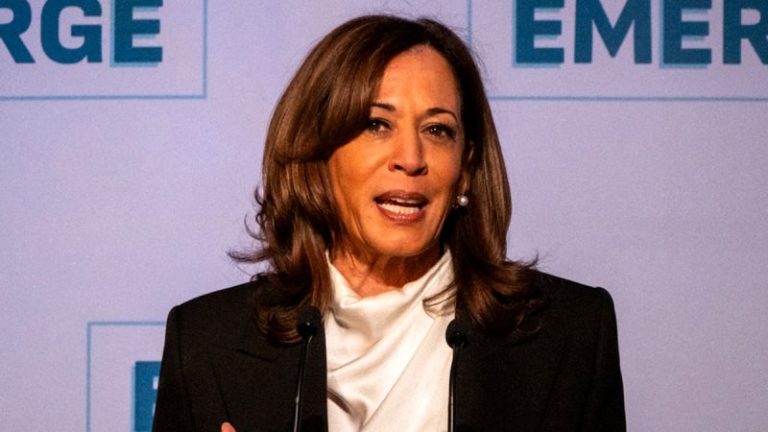
Former Vice President Kamala Harris noted that she was unaware that she had ‘pulled the pin on a hand grenade’ with her response to a question while appearing on ‘The View’ ahead of the 2024 presidential election, according to an Associated Press report about the unsuccessful candidate’s forthcoming book about her whirlwind 2024 White House campaign.
Asked whether she would have done anything differently than President Joe Biden, Harris replied by saying nothing ‘comes to mind’ and adding that she had ‘been a part of … most of the decisions that have had impact.’
‘I had no idea I’d just pulled the pin on a hand grenade,’ Harris wrote in her book, ‘107 Days,’ which is slated for release on Tuesday, according to the AP — ‘my staff were besides themselves’ regarding how she had handed a ‘gift to the Trump campaign,’ she noted, according to the outlet.
Harris explained in the book that she did not want to criticize the president or litigate matters on which they did not agree, according to the AP, but she did not grasp the extent to which her connection with Biden was holding back her presidential bid.
President Donald Trump decisively defeated Harris in the 2024 election, winning both the Electoral College and the popular vote.
‘I could barely breathe,’ Harris wrote regarding her experience of learning that she had lost the White House contest to her Republican rival, the outlet reported. She kept asking, ‘My God, my God, what will happen to our country?’
Earlier this year, Harris announced that she had decided against mounting a 2026 California gubernatorial bid.
‘In recent months, I have given serious thought to asking the people of California for the privilege to serve as their Governor,’ she noted in a statement issued in late July. ‘But after deep reflection, I’ve decided that I will not run for Governor in this election.’

The House passed a short-term federal funding bill backed by President Donald Trump on Friday morning, paving the way for averting a government shutdown if the Senate follows suit.
The legislation is aimed at keeping the government funded at current levels through Nov. 21 with a measure known as a continuing resolution (CR), designed to give House and Senate appropriators more time to strike a deal on fiscal 2026 federal spending.
Fiscal 2025 is slated to end on Sept. 30, and Congress risks a partial shutdown if the CR does not make it to Trump’s desk for a signature by then.
In addition to keeping the government open until just before Thanksgiving, the legislation also includes an added $30 million to boost lawmaker security through a mutual aid fund for Capitol law enforcement and local police.
That decision was made as concerns over political violence have skyrocketed in recent months, including after the assassination of conservative activist Charlie Kirk in Utah last week.
The CR also honors a White House request for an additional $58 million in combined security funding for the judicial and executive branches, as well as $1 billion allocated for Washington, D.C.’s budget after Congress repealed that sum earlier this year.
A shutdown could be politically costly for both Republicans and Democrats.
Democratic leaders had threatened for days to oppose the bill, infuriated over being left out of CR negotiations and demanding increased funding for healthcare subsidies.
House Minority Leader Hakeem Jeffries, D-N.Y., was criticizing the CR as recently as Friday morning, less than an hour before the vote.
‘Today, there’s a choice before every single member of the House of Representatives: will we stand up for the healthcare of the American people, or will we bend the knee to Donald Trump and his continued efforts to gut healthcare for everyday Americans?’ Jeffries said.
‘We’re voting no on a partisan Republican spending bill, and we’ll continue to defend the healthcare of the American people.’
Speaker Mike Johnson, R-La., had precious little wiggle room going into the vote, affording to lose only two Republicans if all Democrats turned against it.
But in the Senate, where at least several Democratic votes will be needed to meet the 60-vote threshold to advance the legislation, Minority Leader Chuck Schumer, D-N.Y., is under significant pressure from his left flank to buck the GOP-led bill.
Schumer angered progressives in March when he cast a key vote to help avert a government shutdown with another Republican-led bill.
Republicans, meanwhile, have been readying to place the blame on a potential shutdown squarely on Democrats’ shoulders.
Trump posted on Truth Social on Thursday evening, ‘House Republicans are taking a very important Vote to pass a CLEAN TEMPORARY FUNDING BILL. The Leader of the Democrats, Cryin’ Chuck Schumer, wants to shut the Government down.’
‘Republicans want the Government to stay open. Every House Republican should UNIFY, and VOTE YES!’ Trump wrote.
Democrats released their own alternative CR plan this week, but Johnson told Fox News’ ‘Special Report’ that it was ‘filled with partisan wish lists and poison pills and demands.’
The Senate is expected to consider both versions and could take a vote as early as Friday.
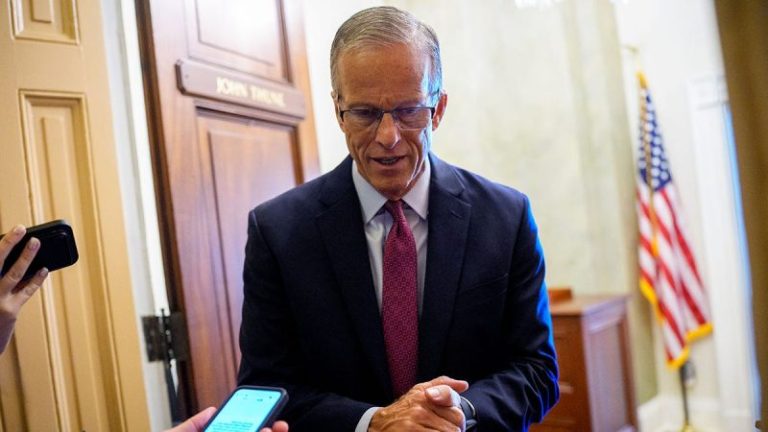
Senate Republicans’ bid to pass a short-term government funding extension was foiled by Senate Democrats as the deadline to fund the government fast approaches.
While the proposal easily glided through the House with little drama, it hit a brick wall in the Senate and failed 44-48. Only one lawmaker, Sen. John Fetterman, D-Pa., crossed the aisle to support the Republican plan. Sens. Rand Paul, R-Ky., and Lisa Murkowski, R-Alaska, also voted against the bill.
Their failure to send the House GOP’s continuing resolution (CR) to President Donald Trump’s desk came on the heels of Democrats’ failed attempt to advance their own counter-proposal to the Republicans’ plan.
It also comes as lawmakers gear up to leave Washington, D.C., for a week to observe the Jewish New Year, Rosh Hashanah. They’re expected to return with just two working days left before the deadline to fund the government on Sept. 30.
‘The House has acted,’ said Senate Majority Leader John Thune, R-S.D. ‘The president’s ready to sign the bill. We’ve got the appropriations committee and a lot of senators who are ready to go to work to pass bipartisan appropriations bills to fund the government by allowing these additional weeks into November. In order to do that, Democrats have to take ‘yes’ for an answer.’
The CR would have kept the government open until Nov. 21, and it included tens of millions for increased security for lawmakers and the judicial and executive branches.
Senate Democrats have dug in against the GOP’s proposal, not so much because of what’s in the bill, but what’s not in it. They have also hung the possibility of a government shutdown on Trump, who demanded that Republicans cut Democrats out of the process.
Thune charged that if Democrats were ‘serious’ about funding the government, they wouldn’t have ‘put out the most partisan piece of legislation you possibly could.’
‘I mean, it’s kind of mind-boggling,’ he said.
Senate Minority Leader Chuck Schumer, D-N.Y., has also accused Thune of not negotiating with him — a point Thune has pushed back against and noted throughout the week that his office is less than 25 yards from Schumer’s.
‘We have two weeks. They should sit down and talk to us, and we maybe can get a good proposal,’ Schumer said. ‘Let’s see. But when they don’t talk to us, there’s no hope of getting a good proposal. And that makes no sense.’
‘And again, when Donald Trump says don’t negotiate with Democrats, because he doesn’t know what the Senate is like, or he doesn’t know how to count, because without Democrats, they’re going to end up shutting down the government,’ he continued.
However, the demands Schumer and Democrats laid out in their counter are a bridge too far for Republicans.
Included in the bill were a permanent extension to COVID-19 pandemic-era Obamacare subsidies, which are set to expire at the end of the year, efforts to repeal the Medicaid cuts in Trump’s ‘big, beautiful bill,’ and a clawback of canceled NPR and PBS funding.
Senate Majority Whip John Barrasso, R-Wyo., told Fox News Digital that the legislation was a ‘Trojan horse by the Democrats.’
‘It’s to me, it’s a preview of what they’re going to want to do,’ he said.
‘Schumer has to play to the far-left fringe that is actually running the Democrat Party right now,’ Barrasso continued.
Senate Democrats are adamant that the Obamacare credits, in particular, need to be dealt with now rather than near the deadline. Sen. Gary Peters, D-Mich., told Fox News Digital that lawmakers ‘have to do it now.’
‘All the [insurance rate] notices go out Oct. 1, so you have to have it now,’ Peters said.
However, Republicans argue that including an extension to the tax credits to a short-term extension isn’t germane to the bill, especially one geared toward trying to give Congress time to fund the government with spending bills. And Thune has said that the credits would be ‘addressed’ after a shutdown was averted.
But for now, the issue at hand still boils down to communication between Thune and Schumer.
‘I mean, these are the leaders of the U.S. Senate,’ Sen. Thom Tillis, R-N.C., said. ‘I expect them to step up. And if one’s not actually reaching out, the other one should at least demonstrate that they are — they’re trying to negotiate in good faith. If they don’t, then they get what they get.’
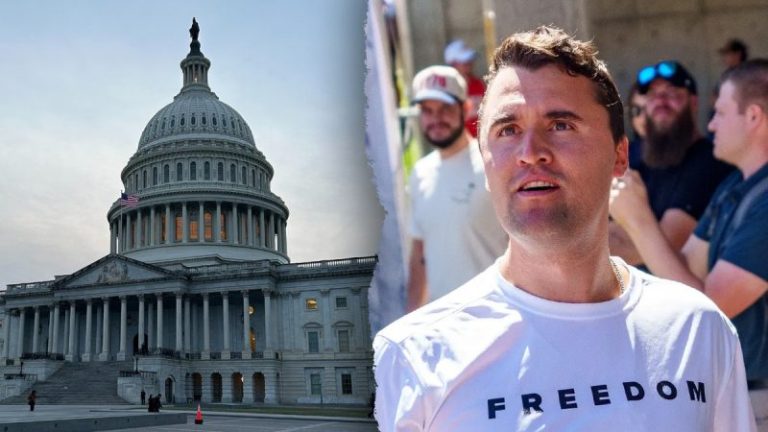
The House of Representatives adopted a resolution to honor the ‘life and legacy’ of late conservative activist Charlie Kirk on Friday, just over a week after he was shot and killed during a college campus speaking event in Utah.
The measure got bipartisan support in a 310-58 vote, with both Democrats and Republicans having quickly risen to condemn political violence in the wake of Kirk’s assassination.
The vote divided Democrats, however, with 95 lawmakers voting to adopt the resolution, 58 voting against it and 22 not voting at all.
Thirty-eight Democrats also voted ‘present’ on the resolution. The top three House Democrats – Minority Leader Hakeem Jeffries, D-N.Y., Whip Katherine Clark, D-Mass., and Caucus Chairman Pete Aguilar, D-Calif. – all voted in favor of the measure.
House Democratic leadership did not expressly tell their caucus how to vote on the resolution but communicated that they would support it, according to two sources familiar with discussions.
The measure to honor Kirk, led by Speaker Mike Johnson, R-La., lauded the Turning Point USA founder as ‘one of the most prominent voices in America, engaging in respectful, civil discourse across college campuses, media platforms and national forums, always seeking to elevate truth, foster understanding and strengthen the Republic.’
It also said Kirk’s ‘commitment to civil discussion and debate stood as a model for young Americans across the political spectrum, and he worked tirelessly to promote unity without compromising on conviction.’
It called his killing ‘a sobering reminder of the growing threat posed by political extremism and hatred in our society’ and ‘calls upon all Americans—regardless of race, party affiliation, or creed—to reject political violence, recommit to respectful debate, uphold American values, and respect one another as fellow Americans.’
The resolution also invoked Kirk’s Christian faith, affirming that the House ‘honors the life, leadership, and legacy of Charlie Kirk, whose steadfast dedication to the Constitution, civil discourse, and biblical truth inspired a generation to cherish and defend the blessings of liberty.’
Despite lawmakers on both sides quickly coming out to condemn Kirk’s killing and political violence as a whole, subsequent days have seen partisan divisions skyrocket over the case.
Rep. Ilhan Omar, D-Minn., was among the Democrats targeted by the right for her response to Kirk’s death, both in an interview on progressive outlet Zeteo News and in reposting a social media video that criticized Kirk’s allies’ responses to his killing.
Rep. Nancy Mace, R-S.C., led a failed bid to censure Omar over her reaction, which was tabled when four Republicans, three of whom cited First Amendment protections, voted to block the measure.