
Author

admin

Browsing

As COP30 convenes in Belém, Brazil, the global urgency to tackle climate change feels sharper than ever.

Meeting ambitious sustainability goals requires mobilizing vast amounts of capital toward clean energy and climate solutions, an endeavor now complicated and accelerated by the surging energy demands of AI technologies. Addressing these evolving needs while advancing climate goals presents both unprecedented challenges and opportunities for investors.

Bruce Kahn, lead portfolio manager at Shelton Capital Management, brings a seasoned voice to this evolving landscape. With over 25 years shaping sustainable equity portfolios and ESG integration, he highlights how renewable energy and innovative investment strategies are critical to powering AI’s growth while advancing climate objectives.

The AI-energy nexus and its investment implications

Kahn underscored a transformative dynamic in the investment landscape: AI’s rapid expansion is driving substantial new energy requirements that existing infrastructure must be ready to accommodate. This convergence creates both risk and opportunity for sustainable investors.

Renewable energy emerges as the fastest and most economically viable option to meet AI’s surging electricity demand.

“If hyperscalers want to have massive data centers, the quickest path to that is going to be deploying renewable energy. Whether that’s in front of the meter or behind the meter, that is the quickest and cheapest way of getting energy,” Kahn said

“There’s still been a lot of talk about nuclear. There’s opportunity there, as well as (with) gas-fired power plants, but those are long-dated situations,” he added, along with challenges around fuel supply. “The quickest way to get power up and running is going to be renewables, and that includes wind. Wind is economical. These projects finance themselves with or without tax credits.”

Khan also cited solar, biofuels and geothermal as cornerstones in this transitioning energy mix. Underlying this transition is a strong demand for the industrial and materials sectors supplying the essential components for renewable infrastructure.

The AI-energy nexus calls for expanded thematic investments, distinct from traditional ESG-focused strategies focused on addressing climate resilience, energy efficiency and industrial transformation related to AI’s pervasive role.

“From a portfolio management and factor management perspective, I have to consider how overweight I am to a factor such as industry, and then an overweight sector, such as industrials and materials. So that becomes a challenge, because that’s where there are a lot of great opportunities, but you know, you have to be very choosy.”

Kahn emphasized the importance of focusing on “core” technology segments, such as fuel enrichment and water quality measurement, which may offer more stable, structural demand and lower volatility compared to early-stage growth technologies.

Reflecting market evolution, Kahn highlighted the growing prominence of infrastructure funds and alternative investment vehicles beyond traditional equities for capturing these themes.

Ongoing innovation in public equities expanding access to smaller growth companies represents a critical frontier for investors seeking exposure to early-stage innovations within the broader energy transition.

Managing portfolio challenges amid technological and geopolitical uncertainty

One key risk Kahn highlights is the potential for slower-than-expected adoption of AI technologies to transform the industrial economy. In this uncertainty, there is also caution against overexposure to assets that might become stranded if energy demand or technology shifts deviate from expectations.

To mitigate this, Shelton Capital focuses on investing in “core” technologies that underlie energy infrastructure and climate solutions, such as fuel enrichment processes and water quality measurement. Climate adaptation sectors like agriculture also feature prominently, reflecting their frontline role in managing climate risks.

Kahn also acknowledges that short-term market volatility and policy shifts create noise, but says they are unlikely to alter the long-term investment trajectory.

“All the data suggests that companies don’t invest balance sheet capital based on four-year or even two-year political wins; they’re investing for 10, 15, 20 years,” he noted. This long-term horizon requires patient, disciplined capital deployment.

“We’re talking to the CEOs of these companies and asking them what their capital plans are. They are not pausing their sustainability initiatives because they’ve proven to themselves that this is a driver of profitability.”

Shelton Capital employs a bottom-up investing philosophy grounded in carefully selected sustainability themes aligned with resilience, human well-being and technological innovation. ESG analysis is integrated as a foundational layer within a broader thematic framework, enabling a comprehensive view of company operations and their contribution to sustainability goals.

Looking ahead: Trends and priorities for COP30 and beyond

COP30 represents a pivotal moment to recognize the intertwined nature of technology advancement, energy infrastructure and climate imperatives.

The immense energy footprint driven by AI technologies presents both daunting challenges and tremendous opportunities within the global climate agenda. The geography of renewable energy deployment is also evolving swiftly, with emerging markets playing a critical role in driving global capacity growth.

“While we may be hamstrung now in the US in the short term, renewable energy is being deployed all over the rest of the world at huge scales,” said Kahn.

Sustainable investment has also emerged as a critical lever to mobilize capital in support of the values of newer generations. Kahn described how deeply embedded sustainability values and significant upcoming wealth transfers position Gen Z and millennials as key drivers of market transformation.

“They’re what I refer to as sustainability native,” he explained. “They kind of came to it naturally. It wasn’t forced on them.

“They are going to have a lot of power, from an investment standpoint, to shape markets, and markets respond to capital,” he added.

Effective climate investing requires a multi-sector, multi-asset approach spanning equity, debt, real estate, commodities and real assets. Investor education and sophisticated portfolio diversification will be pivotal in shaping the future market environment, equipping investors and advisors to align capital with evolving sustainability goals and technological advancement.

Investment managers and advisors must navigate these complexities with agility and insight, steering capital to solutions that drive both financial returns and transformative impact.

As the AI-energy nexus continues to redefine the investment landscape, aligning capital with long-term climate imperatives is no longer optional; it is the blueprint for future value creation.

Securities Disclosure: I, Meagen Seatter, hold no direct investment interest in any company mentioned in this article.


This post appeared first on investingnews.com

InMed Pharmaceuticals (NASDAQ: INM) pairs innovative therapeutic development in Alzheimer’s, ophthalmology, and dermatology with recurring revenue from its BayMedica manufacturing division — giving investors rare small-cap biotech exposure to high-impact science with reduced financing risk.

INM-901 takes a multi-pathway approach to Alzheimer’s, targeting several core drivers of the disease rather than just amyloid beta. In preclinical studies, it protected neurons, reduced inflammation, cleared toxic proteins, and improved cognition, aligning with the industry’s shift toward multi-target therapies.

InMed’s BayMedica subsidiary manufactures rare cannabinoids via chemical synthesis, rather than plant extraction, ensuring purity, consistency and scalability. The business generates approximately $5 million in annual revenue and ~40 percent gross margins, selling to the global health and wellness ingredient markets. This dual business model gives InMed a cash flow-supported R&D engine, enhancing sustainability and valuation resilience.

Investor Insight

InMed is a pharma innovator advancing proprietary small-molecule therapies in Alzheimer’s and ophthalmology, supported by a revenue-producing manufacturing arm. With cash exceeding its market cap and multiple near-term catalysts, it represents a compelling, undervalued biotech opportunity.

This InMed Pharmaceuticals profile is part of a paid investor education campaign.*

Click here to connect with InMed Pharmaceuticals (NASDAQ:INM) to receive an Investor Presentation

This post appeared first on investingnews.com

Mark Skousen of Forecasts & Strategies shares his outlook for gold, silver and the US economy.

‘We’ve entered an era of what I call permanent inflation,’ he explained.

‘After World War II, inflation became permanent — higher and higher prices every year. The inflation rate may ebb and accelerate, but it’s always positive year after year.’

Securities Disclosure: I, Charlotte McLeod, hold no direct investment interest in any company mentioned in this article.

This post appeared first on investingnews.com

Sound money advocate and author Larry Lepard shares his thoughts on what’s driving gold, silver and Bitcoin prices, as well as how high they could rise in the near term.

‘I sincerely believe that in 2026, Bitcoin could double and go to US$200,000. Silver could almost double and go to US$100 or US$80 or US$90 (per ounce), up from US$50,’ he said.

‘And gold stocks could double from where they are.’

Securities Disclosure: I, Charlotte McLeod, hold no direct investment interest in any company mentioned in this article.

This post appeared first on investingnews.com

Questcorp Mining Inc. (CSE: QQQ,OTC:QQCMF) (OTCQB: QQCMF) (FSE: D910) (the ‘Company’ or ‘Questcorp’) is pleased to announce that Sorbie Bornholm LP (‘Sorbie’), a UK Investment Fund, has undertaken an initial investment in Questcorp Mining Inc. (CSE: QQQ,OTC:QQCMF) (OTCQB: QQCMF) (FSE: D910) (‘Questcorp’ or the ‘Company’). The gross amount of the investment is CAD$2,000,000. The funds will go toward advancing Questcorp’s ongoing exploration and development programs at its flagship La Union Gold and Silver Project in Sonora, Mexico, and its North Island Copper Property on Vancouver Island, British Columbia, and for general working capital purposes.

Reflecting on the new partnership, President & CEO, Saf Dhillon, commented:

‘We are incredibly pleased to have secured this strategic investment from Sorbie Bornholm, a respected international institutional investor. This financing provides us with the flexibility to accelerate exploration across our key assets in Mexico and British Columbia. We view Sorbie’s participation as a strong vote of confidence in Questcorp’s team, vision, and long-term potential to deliver value through discovery and development.’

Whitney Kofford, Managing Director of Sorbie Bornholm LP, added:

‘We are delighted to welcome Questcorp Mining Inc. as a new partner and portfolio company. Our decision to invest reflects our enormous confidence in Questcorp’s leadership. And in turn, by entering into a Sharing Agreement, Questcorp’s leadership signals strong conviction in their ability to execute and grow value for all stakeholders. Sorbie’s Sharing Agreement is designed to align interests towards growth and provide companies with consistent capital that rewards operational success and share price appreciation. We trust Questcorp will use the capital support to systematically unlock long-term value for all shareholders, and we look forward to sharing in their great upside potential.’

About Sorbie Bornholm

Sorbie Bornholm LP is a global investment firm that provides funding for ongoing business objectives to listed micro, small and mid-cap growth companies. We focus on public equity investments in companies that are looking to expand and on management teams with a clear growth strategy. Our extensive experience allows us to invest in most industries in order to provide supportive, longer-term capital that rewards company growth.

Since 2000, Sorbie Bornholm LP founder Greg Kofford has perfected the ‘Sorbie-Strategy’, utilizing a sharing agreement that supports management and rewards growth. This unique approach has now been used in over 50 investments – with many of those resulting in the companies receiving more cash than the original offering proceeds – without having to issue any additional shares.

Sorbie Bornholm’s core values drive who we are and how we invest. We are committed to developing long-term relationships with select listed public companies and their brokers & advisers. We focus on providing supportive, longer-term capital that rewards growth. We invest to make a difference, to become a valued partner and to be a shareholder of choice. It’s important to us that we succeed together.

To see if the Sorbie-Strategy is right for your company, please contact Sorbie Bornholm:

Whitney Kofford, Managing Director
+1-801-554-5889
whitney@sorbiebornholm.com https://sorbiebornholm.co.uk/

About Questcorp Mining Inc.

Questcorp Mining Inc. is engaged in the business of the acquisition and exploration of mineral properties in North America, with the objective of locating and developing economic precious and base metals properties of merit. The Company holds an option to acquire an undivided 100% interest in and to mineral claims totaling 1,168.09 hectares comprising the North Island Copper Property, on Vancouver Island, British Columbia, subject to a royalty obligation. The Company also holds an option to acquire an undivided 100% interest in and to mineral claims totaling 2,520.2 hectares comprising the La Union Project located in Sonora, Mexico, subject to a royalty obligation.

Contact Information

Questcorp Mining Corp.

Saf Dhillon, President & CEO

Email: saf@questcorpmining.ca
Telephone: (604) 484-3031

This news release includes certain ‘forward-looking statements’ under applicable Canadian securities legislation. Forward-looking statements include, but are not limited to, statements with respect to the intended use of proceeds from the Offering. Forward-looking statements are necessarily based upon a number of estimates and assumptions that, while considered reasonable, are subject to known and unknown risks, uncertainties, and other factors which may cause the actual results and future events to differ materially from those expressed or implied by such forward-looking statements. Such factors include, but are not limited to: the ability of Riverside to secure geophysical contractors to undertake orientation surveys and follow up detailed survey to confirm and enhance the drill targets as contemplated or at all, general business, economic, competitive, political and social uncertainties, uncertain capital markets; and delay or failure to receive board or regulatory approvals. There can be no assurance that the geophysical surveys will be completed as contemplated or at all and that such statements will prove to be accurate, as actual results and future events could differ materially from those anticipated in such statements. Accordingly, readers should not place undue reliance on forward-looking statements. The Company disclaims any intention or obligation to update or revise any forward-looking statements, whether as a result of new information, future events or otherwise, except as required by law.

To view the source version of this press release, please visit https://www.newsfilecorp.com/release/273793

News Provided by Newsfile via QuoteMedia

This post appeared first on investingnews.com

Senate Republicans unveiled a crucial piece of the puzzle in their bid to reopen the government and plan to plow ahead with a vote on Sunday. 

While both sides still appear at an impasse on extending expiring Obamacare subsidies, appropriators moved ahead with a package of spending bills that Republicans hope will jumpstart the government funding process, and lead to an end to the 40-day government shutdown. 

The Senate Appropriations Committee released the three-bill spending package, known as a minibus, Sunday afternoon. Lawmakers are still waiting on text for an updated continuing resolution (CR), that, if passed, is expected to reopen the government until late January. 

It includes legislation that would fund military construction and the VA, the legislative branch and agriculture and the Food and Drug Administration.

Senate Republicans view the package as a sweetener that they hope attracts enough Senate Democrats to break through the logjam and move toward reopening the government. And given that the minibus is a largely bipartisan product, lawmakers believe it could succeed. 

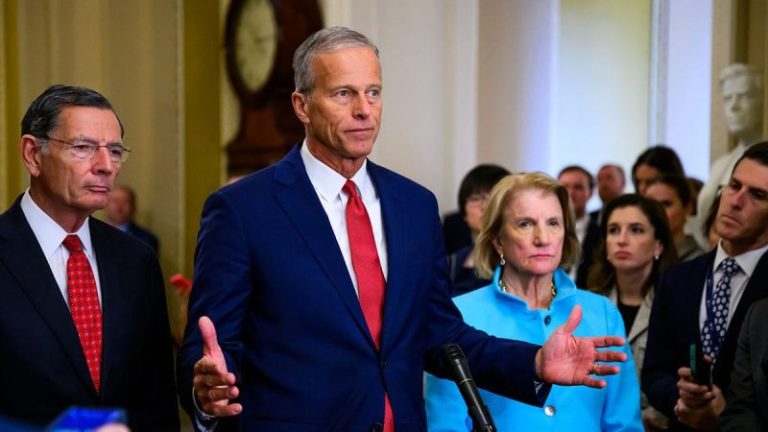
Senate Majority Leader John Thune, R-S.D., made clear in the last few days that he would not put a bill on the floor that did not have the votes to pass after spending several weeks daring Senate Democrats to vote against the original House-passed continuing resolution (CR). 

‘There’s going to be something to vote on, let’s put it that way,’ Thune said. 

Still, the package does not include a deal on Senate Democrats’ chief demand throughout the government shutdown to extend expiring Obamacare subsidies. 

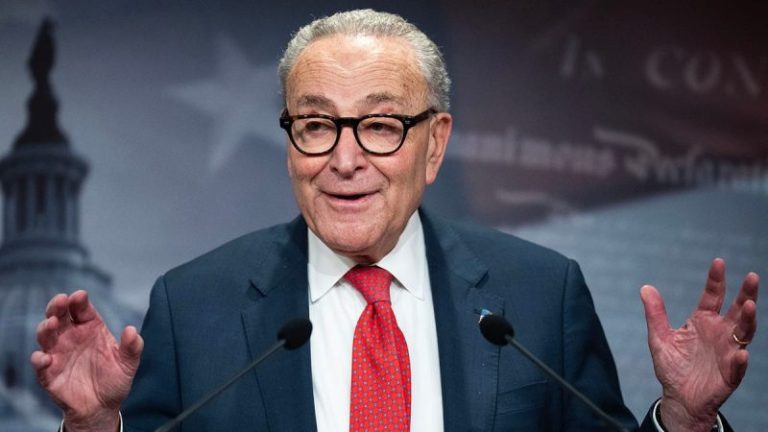
Thune has promised Senate Minority Leader Chuck Schumer, D-N.Y., and his caucus a vote on the expiring subsidies after the government reopens. And for several weeks, Senate Democrats said that was not enough to assuage the concerns. 

Senate Democrats are expected to huddle Saturday night before a likely vote to plot a path forward. If Schumer and his caucus agree to the deal, they would effectively be caving from their deeply-entrenched position that has seen the government shutdown stretch over a month. 

Lawmakers will now have time to read over the bills, with a vote expected later Sunday evening. 

But, it’s just the first step in what could be a long and drawn-out process. First, Thune will tee up the original House-passed CR for a vote, which lawmakers view as the vehicle to attach the minibus and updated CR to. 

Then there will be two more votes before the package advances from the Senate. Then, it will have to go back to the House before making its way to President Donald Trump’s desk. 

Schumer and his caucus could still apply pain on the process, too, through procedural hurdles. And despite rumblings of some in the caucus ready to break ranks, some Republicans aren’t too optimistic that this will be an easy process. 

‘I don’t expect anything from the Democrats,’ Sen. Markwayne Mullin, R-Okla., said. ‘At this point, their demands have been so ridiculous, I don’t know what they’re going to do, and at this point, I frankly, don’t give a crap.’ 

This post appeared first on FOX NEWS

The Iranian regime has managed to smuggle at least $1 billion to its terrorist proxy Hezbollah in Lebanon despite heavy sanctions this year, top officials at the U.S. Treasury Department say.

John Hurley, the undersecretary for terrorism and financial intelligence, says Iran remains committed to its proxy groups throughout the Middle East. Nevertheless, he says there is any opportunity to cut off the funding streams while Iran is in its current weakened state.

‘There’s a moment in Lebanon now. If we could get Hezbollah to disarm, the Lebanese people could get their country back,’ Hurley said.

‘Even with everything Iran has been through, even with the economy not in great shape, they’re still pumping a lot of money to their terrorist proxies,’ he continued.

‘The key to that is to drive out the Iranian influence and control that starts with all the money that they are pumping into Hezbollah,’ he argued.

Hurley pushed for the increased pressure campaign during a tour of Turkey, Lebanon, the United Arab Emirates and Israel this weekend.

Western nations have already laid down heavy sanctions on Tehran over its unwillingness to negotiate a nuclear deal. The regime insists its nuclear development program exists solely for civilian purposes.

President Donald Trump ordered bombings on Iran’s key nuclear cites earlier this year in Operation Midnight Hammer, which U.S. officials say succeeded in crippling Tehran’s progress toward a bomb.

Iran has nevertheless continued its efforts to spread chaos across the globe. U.S. officials say they, along with Israel and Mexico, thwarted an Iran-backed attempt to assassinate Israel’s ambassador to Mexico earlier this year.

‘We thank the security and law enforcement services in Mexico for thwarting a terrorist network directed by Iran that sought to attack Israel’s ambassador in Mexico,’ Israel’s foreign ministry told Fox News on Friday.

‘The Israeli security and intelligence community will continue to work tirelessly, in full cooperation with security and intelligence agencies around the world, to thwart terrorist threats from Iran and its proxies against Israeli and Jewish targets worldwide.’

A U.S. official told Reuters the plot targeting ambassador Einat Kranz Neiger ‘was contained and does not pose a current threat.’

Fox News’ Greg Norman and Reuters contributed to this report.

This post appeared first on FOX NEWS

Republican Rep. Riley Moore said the United States could take a range of actions — including sanctions and ‘even kinetic military action’ — in response to what he called the ‘genocide’ of Christians in Nigeria.

Trump designated Moore, a member of the Appropriations Committee from West Virginia, along with Chairman Tom Cole, R-Okla., to lead an investigation into the killing of Christians by Islamist militants in the African nation.

Frustrations with the matter boiled out into the open when Trump this week designated Nigeria as a country of particular concern and ordered the Pentagon to prepare to intervene militarily.

In a video on Truth Social this week, Trump threatened to ‘do things to Nigeria that Nigeria is not going to be happy about’ and ‘go into that now-disgraced country guns-a-blazing.’

Moore told Fox News Digital the designation unlocks ’15 different levers’ the administration can use against Nigeria, including halting arms sales, freezing aid and sanctioning officials or institutions accused of ignoring or enabling religious killings.

‘All options are on the table here for this, even kinetic military action,’ Moore said. ‘That could mean targeted, strategic counterterrorism strikes to get rid of some of the top leadership if that’s what it takes to stop the killing.’

‘We’ve been providing security assistance to this country since at least 2009 – billions of dollars worth of arm sales, training and equipment that they’ve received. And it’s a question of prioritization in what’s important to them. And clearly this has not been one of the most important things.’

The West Virginia Republican said he has been working with the House Appropriations Committee and the State Department to identify what he called ‘legislative levers’ that could support the administration’s response. Moore said he’s also consulting with NGOs and Christian organizations ‘on the ground’ in Nigeria to document the scale of the violence.

He described the attacks as a ‘genocide,’ claiming Christians are being killed at a rate of five to one compared with non-Christians. Moore accused Nigeria’s government of ‘looking the other way’ despite receiving billions in U.S. security aid since 2009.

‘They’re not taking this seriously,’ he said. ‘We had a pastor warn the government about an impending attack — they called it fake news. Within 24 hours, that pastor and 20 of his congregants were murdered.’

The Nigerian government denies a genocide is taking place. ‘Portraying Nigeria’s security challenges as a targeted campaign against a single religious group is a gross misrepresentation of reality. Terrorists attack all who reject their murderous ideology — Muslims, Christians, and those of no faith alike,’ the office of the presidency wrote on X. 

Moore said he and House Appropriations Chairman Tom Cole, R-Okla., plan to meet with Nigerian officials in Washington this month as part of the investigation, and may even send delegations to the nation. He added that the U.S. could still work with Nigeria’s government if it shows a willingness to confront extremist groups.

‘It’s not all sticks here — there are some carrots in this,’ Moore said. ‘If they’re willing to work with us, this could actually lead to a stronger relationship between our countries.’

The Nigerian government has denied that the killings amount to religious persecution, arguing that extremist and criminal groups target civilians of all faiths.

With a population of more than 230 million, Nigeria’s vibrant and often turbulent cities and villages are home to people of strikingly diverse backgrounds. The country’s more than 500 languages and mix of Islam, Christianity, and traditional indigenous faiths have long been marred by tension.

Nigeria’s faith communities remain sharply divided, with Muslims dominating the northern regions and Christians concentrated in the south.

Christianity took firm root in the 19th century, when freed slaves educated in Sierra Leone returned home as teachers and missionaries — establishing schools, churches, and early congregations that continue to shape southern Nigeria’s identity today.

Despite vast oil and mineral wealth, decades of corruption and mismanagement have left much of the nation impoverished.

Nigeria’s growing cache of lithium, cobalt, nickel, and other rare minerals has drawn quiet U.S. attention as Washington looks to counter China’s dominance in Africa’s critical-minerals market. The Commerce Department and U.S. International Development Finance Corp. have eyed investment opportunities in Nigeria’s nascent lithium industry, but persistent insecurity in mining regions threatens Western access and future development.

For over a decade, Nigeria’s Christians fleeing the nation’s northern half have been subject to the violence of Boko Haram, an Islamist militant group known for its terrorist spectacles. Churches and homes burned, communities vanishing in the group’s night raids.

Numbers are difficult to verify, but the International Society for Civil Liberties and Rule of Law reports at least 52,000 Christians have been killed, some 18,500 abducted and unlikely to have survived, and 20,000 churches and Christian schools attacked between 2009 and 2023.

In 2014, Boko Haram famously kidnapped and enslaved 276 teenage girls in a raid on a high school dormitory. The group regularly arms children as suicide bombers and holds slave markets in captured territories.

But a direct U.S. military campaign would prove difficult with current U.S. assets in the nation and is unlikely, one defense official told Fox News Digital.

The United States currently has no permanent military base in Nigeria, though small teams of U.S. advisors and special operations trainers work periodically with Nigerian forces under AFRICOM programs.

Washington approved about $600 million in security aid to Nigeria over the past decade, mostly focused on counterterrorism in the northeast.

This post appeared first on FOX NEWS

The Federal Aviation Administration (FAA) started reducing air traffic across 40 airports Friday due to air traffic controller staffing issues stemming from the government shutdown.

As the government shutdown has hit 40 days, more air traffic control workers have refused to come to work as they’re about to miss a second paycheck next week — prompting the FAA to make cuts to ensure no safety issues arise.

But these flight reductions will likely continue if the shutdown does — or worsen — and could impact thousands of flights daily, according to Marc Scribner, a senior transportation policy analyst at the libertarian Reason Foundation think tank.

‘This would affect thousands of flights per day, and tens of thousands of passengers potentially seeing their flights canceled — a major disruption,’ Scribner told Fox News Digital Thursday.

As of Sunday, there are now enough Senate Democrats willing to back a revamped plan to reopen the government. But if the shutdown doesn’t end, air travel disruptions are at risk. 

‘I don’t think we would expect, if the shutdown continues, for staffing levels to improve over what they are right now,’ Scribner said. ‘If anything, they will continue to deteriorate as controllers call out sick or perhaps even resign. So I would expect it would not get better as long as the shutdown continues.’

Scribner said that travelers shouldn’t be concerned that the reduction in flights would translate to a lapse in safety, but said they should be aware that their travel schedules will likely take a hit as a result.

‘They’re not going to allow unsafe flights. So whatever that means in terms of staffing capability and workflow, they are going to reduce the flights in order to maintain that very high level of safety that’s demanded of that,’ Scribner said. ‘Travelers shouldn’t be concerned about safety in this, but they should be concerned about their travel schedules, which are likely to be impacted.’

Richard Stern, director of the Grover M. Hermann Center for the Federal Budget at conservative think tank The Heritage Foundation, also said he expects this reduction to continue until the shutdown ends. 

‘Unfortunately, I think it’s going to have to continue until the shutdown ends, because they’re running through resources that they don’t have until this funding again,’ Stern told Fox News Digital Thursday. 

Stern said the government has been entering into uncharted territory now with what minimum services the government is required to provide, despite the fact that funding has expired. 

‘No one really knows exactly what the next steps are after this,’ Stern said. 

No clarity has been provided regarding how long this reduction in flights is expected to continue. The Department of Transportation, which oversees the FAA, did not immediately respond to a request for comment from Fox News Digital.

The FAA said Friday that air traffic will be cut by 10% in the coming days across 40 ‘high-volume’ markets, including those in major cities like Atlanta, Denver, Dallas, Orlando, Miami and San Francisco, according to a list of airports obtained by The Associated Press. Major metropolitan areas with several airports like New York and Chicago will have outages at multiple locations.

Reducing air traffic in response to the lapse in funding from the government shutdown is unprecedented, according to FAA Administrator Bryan Bedford.

‘I’m not aware in my 35-year history in the aviation market where we’ve had a situation where we’re taking these kinds of measures,’ Bedford said at a news conference Wednesday.

Air traffic controllers have been working without pay since the shutdown kicked off Oct. 1, and often are required to work six days a week in addition to mandatory overtime.

Bedford said that the decision to reduce air traffic was made in order to prevent a crisis from emerging, amid increased staffing pressures and voluntary safety reports from pilots suggesting that air traffic controllers were facing heightened levels of fatigue.

‘We’re not going to wait for a safety problem to truly manifest itself when the early indicators are telling us we can take action today to prevent things from deteriorating,’ Bedford said. ‘The system is extremely safe today and will be extremely safe tomorrow. If the pressures continue to build even after we take these measures, we’ll come back and take additional measures.’

The Associated Press contributed to this report.

This post appeared first on FOX NEWS

The Senate took a massive step forward on its way to reopening the government on Sunday, with a group of Senate Democrats caving and joining Republicans in their bid to pass a revamped plan to end the shutdown.

Signs that the shutdown, which entered its 40th day, could be ending became more and more clear as the day went on, particularly with the unveiling of a bipartisan package of spending bills that lawmakers hope to attach to a modified bill to reopen the government.

Eight Senate Democrats crossed the aisle to mark the first step in the GOP’s quest to end the shutdown. Many of the lawmakers that splintered from Senate Minority Leader Chuck Schumer, D-N.Y., were among those engaged in bipartisan talks over the last several weeks.

Among the defectors were Sens. Angus King, I-Maine, John Fetterman, D-Pa., Catherine Cortez Masto, D-Nev., Jeanne Shaheen, D-N.H., Maggie Hassan, D-N.H., Jacky Rosen, D-N.M., Tim Kaine, D-Va., and the number two Democrat in the Senate, Dick Durbin, D-Ill.

‘The question was, does the shutdown further the goal of achieving some needed support for the extension of the tax credits? Our judgment was that it will not,’ King said. ‘It would not produce that result. And the evidence for that is almost seven weeks of fruitless attempts to make that happen.’

Schumer and Senate Democrats long stayed the course that they would only vote to reopen the government in exchange for a solid deal on extending expiring Obamacare subsidies.

But the solution developed over the last several days included nothing of the sort. While there were some wins in the updated continuing resolution (CR), like reversals of some of the firings of furloughed workers undertaken by the Trump administration and guaranteeing back pay for furloughed workers, there was no guaranteed victory in sight on the Obamacare issue.

That means that Senate Democrats effectively caved with little to show for their healthcare push, save for the guarantee of a vote on the subsidies from Senate Majority Leader John Thune, R-S.D., which was reflected in the updated CR. 

Schumer panned the compromise deal, and charged that when Republicans rejected Democrats’ own counter-proposal that would have extended the expiring subsidies for a year, ‘They showed that they are against any health care reform.’

‘This healthcare crisis is so severe, so urgent, so devastating for families back home that I cannot, in good faith, support this CR that fails to address the healthcare crisis,’ Schumer said. 

Thune was optimistic that the plan would work, and reiterated his promise of a vote on the expiring subsidies. However, whatever legislation is produced to address the Obamacare issue is likely to fail. 

Regardless, as I have said for weeks to my Democrat friends, I will schedule a vote on their proposal, and I’ve committed to having that vote no later than second week in December,’ he said. 

Progressives in the caucus were unhappy with the developments, too.

Sen. Bernie Sanders, I-Vermont, charged that it would be a ‘horrific mistake’ for Democrats to cave now without an Obamacare deal.

‘If Democrats cave on this issue, what it will say to Donald Trump is that he has a green light to go forward toward authoritarianism,’ Sanders said. ‘And I think that would be a tragedy for this country.’

Still, there is a long way to go before the government officially reopens.

Sunday’s vote was the first in a series needed in the Senate to modify the original House-passed continuing resolution and combine it with the three-bill spending package and updated CR, which, if passed, would reopen the government until Jan. 30, 2026.

Lawmakers hope that if given the extra time, they could finish funding the government with spending bills rather than turning to another CR or colossal omnibus spending package, which crams all 12 government funding bills into one piece of legislation.

‘If we blow this window, we’re going to get stuck with a yearlong CR,’ Sen. John Hoeven, R-N.D., said.

And the shutdown won’t end in the Senate, given that the changes to the legislation will need to be greenlit by the House before making it to President Donald Trump’s desk.

Democrats could still extract pain through procedural hurdles unless there is unanimous agreement from all 100 senators to move forward with the remaining votes.

The Obamacare issue is still bubbling on both sides of the aisle, however. Senate Republicans slammed the state of healthcare throughout Saturday, particularly over how the subsidies funneled money to insurance companies.

Democrats still remained skeptical if their frustration, and desire to make changes to take on insurance companies, was legitimate.

‘The point, I think that’s really relevant here, is if they’re serious, and I really question whether that’s the case,’ Sen. Ron Wyden, D-Ore., said.

This post appeared first on FOX NEWS