
Author

admin

Browsing

Dalaroo Metals Ltd (ASX: DAL, “Dalaroo” or “Company”) is pleased to announce the results of its 2025 exploration program completed at the Company’s 100%-owned Blue Lagoon Project in Greenland (Figure 1).

Highlights

  • Maiden sampling program at the Blue Lagoon Project (Blue Lagoon) unlocks new Zirconium (Zr) and Rare Earth Elements (REE) potential district in Greenland.
  • First sampling program at Blue Lagoon since 1979 has successfully returned elevated Zr + REE mineralisation. All 113 samples returned anomalous values, across a ~2.7km strike – indicating a highly prospective new critical metals district in Greenland.

Zirconium & Hafnium

  • Exceptional high-grade Zirconium Oxide (ZrO2) and Hafnium Oxide (HfO2) surface samples include:
    • 4.42% ZrO2 & 98ppm HfO2 (Sediment Sample 26818D)
    • 4.09% ZrO2 & 99ppm HfO2 (Sediment Sample 26817D)
    • 3.82% ZrO2 & 82ppm HfO2 (Sediment Sample 26808D)
    • 3.58% ZrO2 & 61ppm HfO2 (Sediment Sample 26820D)
    • 3.13% ZrO2 & 62ppm HfO2 (Sediment Sample 26803D)
    • 2.85% ZrO2 & 73ppm HfO2 (Sediment Sample 26806D)
  • >2% ZrO2 and >40ppm HfO2 encountered in auger holes and sediment samples across the entire ~2.7km strike, indicating a large-scale, broad and well mineralised target area.
  • Hafnium is a critical semiconductor metal, which has become vital for supercharging the next-generation microchips and semiconductors, due to its high-K constant (dielectric constant) allowing Hafnium to store significantly more electrical charge than traditional SiO2 based semiconductors.
  • HfO2 has a K-constant approximately ~6x higher than SiO2, with one of the highest melting points of any compound, resulting in >1000x reduction in electron leakage through transistors versus SiO2 – underpinning the next generation of high-performing semiconductors1.
  • HfO2 (High Purity) indicative sale price currently at AU $16,297/kg, reflecting its advanced chemical properties, increasing demand in high‑tech applications, and the scarcity of hafnium‑bearing minerals2.
    • Blue Lagoon sampling has confirmed a ~2.7km strike with >2% ZrO2 and >40ppm HfO2 at surface, with potential for Hafnium grades to concentrate further at depth, subject to drilling confirmation.

Rare Earths

  • The Blue Lagoon Project has returned high-grade REE results with consistent elevated Magnet Rare Earth Oxides (MREO)13 encountered at surface, with Total Rare Earth Oxide (TREO)13,16 grades highlighted by:
    • 8,079 ppm TREO with 29% MREO (Sediment Sample 26824D)
    • 6,491 ppm TREO with 27% MREO (Sediment Sample 26801D)
    • 5,668 ppm TREO with 27% MREO (Sediment Sample 26824C)
    • 5,654 ppm TREO with 27% MREO (Sediment Sample 26823D)
    • 5,519 ppm TREO with 25% MREO (Sediment Sample 26818D)
  • Blue Lagoon has shown exceptional Heavy Rare Earth Oxides (HREO)14,15 enriched in Dysprosium (Dy2O3) and Terbium (Tb4O7) grades encountered at surface, unlocking a new completely untapped district in Greenland:
    • 886ppm HREO (Sediment Sample 26824D)
    • 752ppm HREO (Sediment Sample 26801D)
    • 742ppm HREO (Sediment Sample 26823D)
    • 682ppm HREO (Sediment Sample 26807D)
    • 654ppm HREO (Sediment Sample 26806D)
    • 628ppm HREO (Sediment Sample 26818D)
    • 615ppm HREO (Sediment Sample 26808D)
    • 597ppm HREO (Sediment Sample 26824C)
    • 596ppm HREO (Sediment Sample 26817D)
    • 589ppm HREO (Sediment Sample 26822D)
    • 559ppm HREO (Sediment Sample 26820D)
  • TREO grades and HREO grades have the strong potential to improve as Dalaroo continues to assess full district potential of the Blue Lagoon Project and drill test immediate targets to determine the scale of the mineralised system.
  • Importantly, sampling at Blue Lagoon has returned low Uranium levels, with a maximum reading of 25ppm U3O8 which has the potential to simplify processing complexities and encouragingly falls below the 100ppm uranium threshold levels for permitting in Greenland
  • Placer & Liberated REE Potential: These exceptional REE grades were encountered at surface, consistently over the entire ~2.7km strike. With the natural weathering having enriched the REE into beach-like alluvial sediments – indicating potential for a proximal placer style REE deposit, where REE grains have been freely-liberated and has the potential to produce a REE concentrate through low CAPEX, simple physical separation methods.

Click here for the full ASX Release

This post appeared first on investingnews.com

The company that owns the iconic luxury retailer Saks Fifth Avenue filed for bankruptcy late Tuesday.

The move comes after Saks Global struggled with debt it took on to buy rival Neiman Marcus, lagging department store sales and a rising online market.

It’s one of the largest retail collapses since the Covid pandemic, and casts further doubt over the future of luxury fashion.

The retailer, which also owns Bergdorf Goodman, said early Wednesday its stores would remain open for now after it finalized a $1.75 billion financing package and appointed a new CEO.

The court process is meant to give the luxury retailer room to negotiate a debt restructuring with creditors or sell itself to a new owner to stave off liquidation. Failing that, the company may be forced to shutter.

Former Neiman Marcus CEO Geoffroy van Raemdonck will replace Richard Baker, who was the architect of the acquisition strategy that left Saks Global saddled with debt.

The company also appointed former Neiman Marcus executives Darcy Penick and Lana Todorovich as chief commercial officer and chief of global brand partnerships at Saks Global, respectively.

Saks Fifth Avenue, the retail arm of Saks Global, listed $1 billion to $10 billion in assets and liabilities, according to court documents filed in U.S. Bankruptcy Court in Houston.

A retailer long loved by the rich and famous, from Gary Cooper to Grace Kelly, Saks fell on hard times after the pandemic, as competition from online outlets rose, and brands started more frequently selling items through their own stores.

The original Saks Fifth Avenue store, known for displaying the likes of Chanel, Cucinelli and Burberry, was opened by retail pioneer Andrew Saks in 1867.

The new financing deal would provide an immediate cash infusion of $1 billion through ‌a loan from an investor group, Saks Global said.

A host of luxury brands were among the unsecured creditors, led by Chanel and Gucci owner Kering at about $136 million and $60 million respectively, the court filing said. The world’s biggest luxury conglomerate, LVMH, was listed as an unsecured creditor at $26 million. In total, Saks Global estimated there were between 10,001 and 25,000 creditors.

In 2024, Baker had masterminded the takeover of Neiman Marcus by Canada’s Hudson’s Bay Co, which had owned Saks since 2013, and later spun off the U.S. luxury assets to create Saks Global, bringing together three names that have defined American high fashion for more than a century.

The deal was designed to create a luxury powerhouse, but it saddled Saks Global with debt at a time when global luxury sales were slowing, complicating an already difficult turnaround for CEO and veteran executive Marc Metrick.

Saks Global struggled last year to pay vendors, who began withholding inventory, disrupting the company’s supply chain and leaving it with insufficient stock.

The thinly stocked shelves may have driven shoppers away to rivals like Bloomingdale’s, which posted strong sales in 2025, compounding pressure on Saks Global.

“Rich people are still buying,” Morningstar analyst David Swartz said last month, “just not so much at Saks.”

Running out of cash, Saks Global last month sold the real estate of the Neiman Marcus Beverly Hills flagship store for an undisclosed amount. It had also been looking to sell a minority stake in exclusive department store Bergdorf Goodman to help cut debt.

On Dec. 30, it failed to make an interest payment of more than $100 million to bondholders.

This post appeared first on NBC NEWS

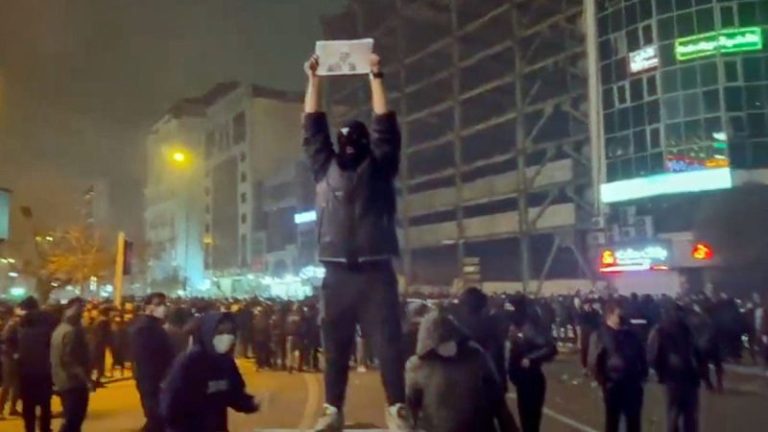
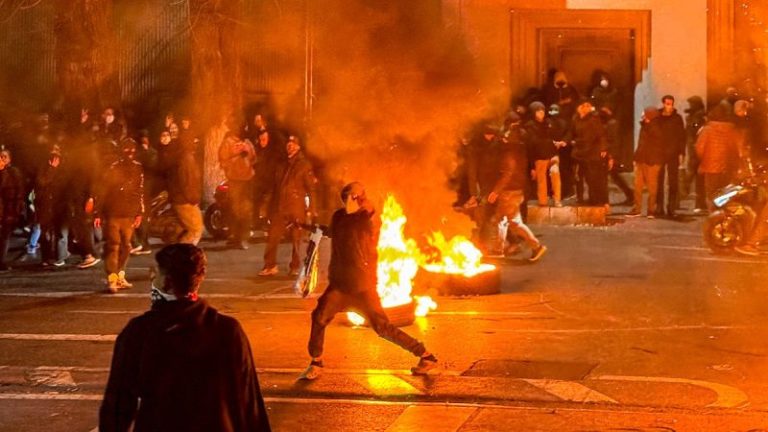
Democrats and Republicans are united in opposing U.S. military strikes against Iran to retaliate for the killing of protesters amid a wave of massive demonstrations against the Iranian government in recent weeks, according to a new national poll.

Seventy percent of voters questioned in a new Quinnipiac University survey said they think the U.S. should not get involved militarily in Iran, with 18% saying the U.S. should take military action.

The vast majority of Independents (80%-11%) and Democrats (79%-7%), as well as a majority of Republicans (53%-35%) said the U.S. should not get involved if protesters in Iran are killed while demonstrating against the regime.

The poll, conducted Jan. 9–12, comes as President Donald Trump has turned up the heat on the regime in Tehran, threatening strikes on Iran if its forces continue to kill demonstrators.

The U.S.-based Human Rights Activists News Agency announced Tuesday that nearly 2,000 people have been killed in the protests. Other reports say the death toll is over 3,000, with the real number likely to be even higher. 

The protests against Iran’s dire economic conditions, which have rapidly escalated in recent days, are seen as some of the most violent since the 1979 Islamic Revolution that installed the current system of clerical rule.

Trump took to social media earlier this week, urging ‘Iranian Patriots, KEEP PROTESTING — TAKE OVER YOUR INSTITUTIONS.’

The president also said that ‘HELP IS ON ITS WAY,’ and apparently pointing to Iranian authorities, he warned, ‘They will pay a big price.’

Pointing to the possibility of Iranian authorities executing some of the protesters, Trump said in a CBS News interview this week, ‘If they do such a thing, we will take very strong action.’

And the White House confirmed on Monday that Trump was weighing whether to bomb Iran in reaction to the crackdown.

But seven in 10 questioned in the poll said that, in general, a president should first receive congressional approval before deciding to take military action against another country.

‘Talk of the U.S. military potentially intervening in Iran’s internal chaos gets a vigorous thumbs down, while voters signal congressional approval should be a backstop against military involvement in any foreign crisis,’ Quinnipiac University polling analyst Tim Malloy said.

But there’s a partisan divide, with 95% of Democrats and 78% of Independents saying a president should first receive approval from Congress, but Republicans, by a 54%-35% margin, saying congressional approval is not needed.

Trump last June ordered U.S. military strikes on three Iranian nuclear facilities as part of Operation Midnight Hammer, amid fighting between Tehran and Israel.

Voters are also divided on Trump’s move earlier this month to capture Venezuelan President Nicolás Maduro and his wife and bring them to the U.S. to face drug trafficking charges. Forty-seven percent supported the president’s decision, with 45% opposed.

And there was an expected partisan divide, with 85% of Republicans supporting the military action to capture Maduro, with 79% of Democrats opposed. Independents were divided.

More than half of voters (57%) opposed the U.S. running Venezuela until Washington is satisfied that the government there will operate the way the U.S. wants it to. Nearly three-quarters (73%) said they opposed sending U.S. ground troops to Venezuela and 55% opposed the U.S. taking over the South American country’s oil sales.

‘Voters are divided on the merits of overthrowing Maduro. And while split on whether in the long run the people of Venezuela will be better off, they strongly disapprove of America’s temporary domain over Venezuela and are heartily against putting U.S. troops on the ground,’ Malloy noted.

Trump has also turned up the volume in his efforts to acquire Greenland from Denmark.

‘The United States needs Greenland for the purpose of national security,’ the president argued in a social media post Wednesday.

Trump’s push for the U.S. to acquire Greenland is causing tension with Denmark and other NATO allies who insist that the semiautonomous Danish territory should determine its own future. 

Trump officials are openly considering all options, including military force, to take Greenland, spurring bipartisan opposition from some in Congress.

According to the poll, 86% of voters said they would oppose military action to take over Greenland. And by a 55%-37% margin, voters said they opposed trying to buy Greenland.

But there’s a stark political divide, with more than two-thirds of Republicans supporting efforts to buy or capture Greenland.

This post appeared first on FOX NEWS

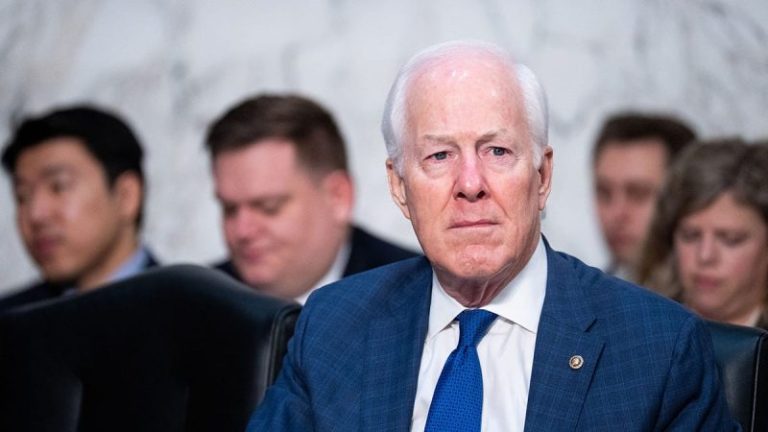
A Senate Republican wants to crack down on childcare providers convicted of fraud with legislation that would, among a handful of tweaks to current law, require the fraudsters to pay back the misspent taxpayer money.

The bill from Sen. John Cornyn, R-Texas, would amend the Child Care and Development Block Grant Act to impose harsher penalties on childcare providers convicted of fraud, and one of several moves in the upper chamber to tackle the sprawling Minnesota fraud scandal.

Cornyn’s bill, the Stop Fraud by Strengthening Oversight and More Accountability for Lying and Illegal Activity (SOMALIA) Act, is narrowly tailored toward addressing fraudulent activity in childcare and daycare centers, but the breadth and scope of the unfurling scandal goes beyond that.

Federal prosecutors estimate that up to $9 billion was stolen through a network of fraudulent fronts posing as daycare centers, food programs and health clinics.

‘The Minnesota scandal has exposed a deep-rooted, morally bankrupt fraud empire, and it is clear more must be done to rid our nation of these heinous criminals,’ Cornyn said in a statement to Fox News Digital.

The legislation would require mandatory permanent debarment from all federally funded child care assistance programs, repay misspent federal funds, require referral for federal criminal investigations, and require states to enforce the above bans and halt providers from evading debarment by restructuring the business or changing the business name.

There’s also an immigration component to the bill that would make non-citizens convicted of fraud deportable, bar them from asylum, adjustment of status, and subject them to mandatory detention and expedited removal.

Cornyn’s effort is one of many coming from the Senate GOP, where lawmakers are looking at several options to crack down on fraud, both in Minnesota and more broadly in the federal government.

Every Senate Republican joined in on a letter to Minnesota Gov. Tim Walz last week, and demanded that he provide a paper trail on the state’s role in the scandal. And Senate Majority Leader John Thune, R-S.D., floated that budget reconciliation, the same procedure used to pass President Donald Trump’s ‘big, beautiful bill,’ could be used to deal with fraud.

And the Trump administration has moved to or threatened cancellation of federal funds to the state in the wake of the scandal.

‘I applaud President Trump for his efforts to end this corruption, and I’m proud to take it a step further with the Stop Fraud by SOMALIA Act, which would ensure these consequences are enshrined into law before any more funds are misused or sent overseas to fund American-hating terrorist networks like we saw in now-disgraced Governor Walz’s state,’ Cornyn said.

This post appeared first on FOX NEWS

The Iranian regime has allegedly broadcast at least 97 ‘coercive confessions’ from detained protesters on state television in just over two weeks, human rights groups say, as residents endure the longest internet blackout on record.

The videos reportedly feature handcuffed detainees with blurred faces showing remorse for their actions since the protests began Dec. 28, according to a rights group tracking the videos.

It said ominous music can be heard, and edited footage shows attacks on security forces, according to reporting by The Associated Press and data from the Human Rights Activists News Agency (HRANA).

Other rights groups also claim the confession videos are coerced and obtained under duress, with protesters ‘dragged before cameras under the threat of torture and execution.’

‘The regime’s broadcast of so-called confessions by detained protesters is a threadbare and worn tactic,’ Ali Safavi, a senior official with the National Council of Resistance of Iran (NCRI), told Fox News Digital.

‘Time and time again, the henchmen drag arrested demonstrators before cameras under the threat of torture and execution, coercing them to recant their beliefs or invent absurd stories.’

The broadcasts come amid nationwide protests sparked by public anger over political repression, economic collapse and alleged abuses by security forces.

Demonstrations have spread across major cities despite mass arrests, lethal force and sweeping restrictions on communication.

Safavi said the confessions serve a dual purpose. 

‘First, they are meant to justify the mass slaughter of protesters, no fewer than 3,000, which NCRI President-elect Maryam Rajavi has stated constitute manifest crimes against humanity,’ he said.

‘These forced confessions are designed to demoralize the Iranian people and sow fear and doubt.’

But he said any mass executions or staged confessions ‘won’t achieve that because no amount of televised coercion or repression will break the protesters’ resolve.’

U.S.-based HRANA has warned that forced confessions in Iran frequently follow psychological or physical torture and can carry severe consequences, including death sentences.

‘These rights violations compound on top of each other and lead to horrific outcomes,’ Skylar Thompson, HRANA group’s deputy director, told The Associated Press, adding that the scale of broadcasts is unprecedented.

The confession campaign coincides with a sweeping internet shutdown that has effectively cut the public off from independent information.

According to NetBlocks, Iran’s internet blackout has surpassed 144 consecutive hours, making it one of the longest disruptions ever recorded.

‘The shutdown is still ongoing, making it one of the longest blackouts on record,’ Isik Mater, NetBlocks’ director of research, told Fox News Digital.

‘State TV continues to operate normally via satellite transmission, which does not depend on the public internet, which means households can still watch Iranian state channels even during a near-total shutdown.’

Mater said the blackout magnifies the impact of state propaganda because ‘while the public is cut off, the state relies on broadcast media and its domestic National Information Network to control what people see,’ he said, likening Iran’s information strategy to that of North Korea.

‘A useful comparison is North Korea where the vast majority of citizens there have little to no access to the global internet, yet the state TV and radio broadcast regime propaganda 24/7,’ he said.

‘Information flows through closed systems, like North Korea’s domestic intranet Kwangmyong and not the open internet.’

Mater added that shutdowns are highly selective, with senior officials and state institutions retaining connectivity through ‘whitelisted networks.’

‘Senior officials and state institutions retain connectivity via whitelisted government networks and private links,’ Mater said.

‘This is why Ali Khamenei and other government officials continue posting on global social media platforms during the blackout, enabling the regime to shape the narrative internationally while citizens are unable to document events or even respond.’

This post appeared first on FOX NEWS

France’s ambassador to the United Nations said Paris has strongly condemned Iran’s violent crackdown on nationwide protests, as the French government weighs possible satellite communications support to help Iranians circumvent a near-total internet blackout.

In an exclusive interview with Fox News Digital, Jerome Bonnafont described what he said was an escalation in repression by Iranian authorities and outlined France’s response, including sanctions and diplomatic pressure.

‘We have condemned very, very strongly, at the highest level, the repression against the popular movement in Iran,’ Bonnafont said. ‘This time it seems to me that the repression is even more violent than it used to be.’

His remarks come as France’s foreign minister confirmed Paris is studying the possible transfer of satellite terminals operated by Eutelsat to Iran, following a sweeping internet shutdown imposed by Iranian authorities during the unrest, and as the G7 issued a joint statement condemning Iran’s violent crackdown on nationwide protests. 

The foreign ministers of France, the United States and other G7 nations warned they were prepared to impose additional restrictive measures if Iran continues to violate international human rights obligations.

Earlier Tuesday, Israel’s foreign minister, Gideon Saar, urged France to support designating Iran’s Islamic Revolutionary Guard Corps as a terrorist organization at the EU level during a call with French Foreign Minister Jean-Noel Barrot.

Asked whether France would back such a move, Bonnafont did not address the IRGC designation directly, instead emphasizing existing sanctions and international pressure.

‘There are sanctions against the police of the regime. And there are sanctions also against several individuals, more than 200 people in Iran for these reasons,’ he said.

‘What we have to do is to condemn and to address the right message to the people in Iran and to the regime, so that the regime stops with this massive repression.’

NATO and Europe’s defense responsibility

Bonnafont also addressed repeated calls from President Donald Trump for European allies to shoulder more of NATO’s defense burden, arguing that Europe is already moving in that direction.

‘There is a will by the Europeans to take the full responsibility of the protection of its own continent,’ he said.

He stressed that the approach reflects a long-standing French position. ‘It is a very old theme for the French governments that there has to be within NATO an autonomous, self-capable entity for European defense,’ Bonnafont said, referring to France’s long-standing advocacy for European strategic autonomy, a position repeatedly emphasized by President Emmanuel Macron.

Ukraine as a test case

Bonnafont pointed to Europe’s response to Russia’s war in Ukraine as evidence that European governments are prepared to act collectively when core security interests are threatened.

‘Ukraine has been attacked by Russia four years ago. Now it has been invaded by Russia, and it has decided to resist and to fight for its independence, its territorial integrity, its sovereignty,’ he said.

He described European backing for Kyiv as both unified and extensive. ‘And Europeans are going in support of Ukraine. And what we are doing in terms of financial support is massive. What we are doing in terms of political support is unanimous,’ Bonnafont said.

According to the ambassador, France and the United Kingdom are working to organize what he described as a ‘coalition of volunteers’ to provide Ukraine with long-term security guarantees once negotiations with Russia become possible.

‘When Ukraine enters into discussion with Russia, and when Russia accepts to enter into discussion with Ukraine, and when the elements of a peace, sustainable peace, are put on paper, Ukraine can have security guarantees,’ he said.

Bonnafont also pointed to France’s domestic budget decisions as evidence that Europe is backing rhetoric with resources. ‘There is presently the negotiation of the next budget for France for 2026,’ he said. ‘It includes a strong increase in our defense budget, and it is the only budget that is going to be increased in our whole budget this year.’

UN reform and budget cuts

Beyond NATO and Europe’s defense posture, Bonnafont said France is pushing for institutional reform at the United Nations, where member states recently approved significant budget reductions. ‘The institution has to reform. It always has to reform,’ he said.

‘We decided by consensus with the American government and all the others a budget which presents a reduction of 20% of manpower and a reduction of 15% of the funds allocated to the U.N.,’ Bonnafont added. ‘Give me another example of a public structure that is capable of such an effort in such a short time,’ he said.

Despite the cuts, he defended the U.N.’s relevance. ‘Yes, we are serious about reform. Yes, we want it to be streamlined,’ Bonnafont said. ‘But yes, we need the U.N. for the world.’

UNRWA dispute and U.S. funding cuts

Asked about the U.S. decision to halt funding for several U.N. agencies, including UNRWA, Bonnafont defended the agencies, saying, ‘Organizations are more efficient when they are universal,’ adding that participation remains a sovereign decision for the United States.

This post appeared first on FOX NEWS

Senate Republicans successfully spiked a bipartisan attempt to curb President Donald Trump’s war powers authority after a pair of key GOP lawmakers reversed their positions. 

Republicans turned to a rarely used Senate procedure previously used by Senate Democrats in a similar situation to nullify the Venezuela war powers resolution from Sen. Tim Kaine, D-Va. The successful effort came after five Senate Republicans joined all Senate Democrats to advance the resolution last week. 

Their move drew heavy criticism and anger from Trump, who demanded that they ‘should never be elected to office again.’ 

The resolution was tanked on a 51 to 50 vote, with Vice President JD Vance coming in to break a tie in favor of Trump. 

Turning to the arcane procedural move served as a victory for both the president and Senate Majority Leader John Thune, R-S.D., after last week’s rare defeat on the floor.  

Thune, like several other Republicans, contended that the resolution was not germane to the issues at hand in Venezuela. 

‘We don’t have troops in Venezuela. There is no kinetic action, there are no operations,’ Thune said. ‘There are no boots on the ground. And I think the question is whether or not there ought to be expedited consideration or privilege accorded to something that’s brought to the floor that doesn’t reflect what’s what is current reality in Venezuela.’

‘And so I think it’s very fair for Republicans to question why we ought to be having this discussion right now, particularly at a time when we’re trying to do appropriations bills,’ he continued.

Thune, Senate Republican leadership, Trump and several administration officials launched a pressure campaign on the five original defectors who helped Senate Democrats advance the bill. While not every lawmaker flipped, Sens. Josh Hawley, R-Mo., and Todd Young, R-Ind., proved the decisive votes to help kill the resolution. 

Hawley’s primary concern was whether the administration would place troops in Venezuela, but after several meetings and conversations with Trump administration officials, he was convinced that no further military action would take place. 

‘To me, this is all about going forward,’ Hawley said of his reversal. ‘If the president decides we need to put troops on the ground in Venezuela, then Congress will need to weigh in.’

Young kept tight-lipped about his plan until the vote opened, and explained before walking onto the Senate floor that the deliverables and guarantees he had received from Secretary of State Marco Rubio and the administration were enough for him. 

Among those were promises that if Trump did want to use force against Venezuela, he would first request authorization from Congress, and that Rubio would appear before the Senate Foreign Relations Committee for a public hearing in the coming weeks to give an update on the situation in the region.

‘Those who understand how Congress works, the good and the bad and the ugly, understand that votes like this, in the end, are communications exercises,’ Young said. ‘They’re important communications exercises, but unless you can secure sufficient votes, not only to pass the United States Senate, but to get out of the House, with which is highly questionable, right, and then to override what was an inevitable presidential veto, which is impossible. No one can tell me how we get there.’ 

‘I had to accept that this was all a communications exercise,’ he continued. ‘I think we use this moment to shine a bright light on Congress’ shortcomings as it relates to war powers in recent history.’

Still, Sens. Susan Collins, R-Maine, Lisa Murkowski, R-Alaska, and Rand Paul, R-Ky., joined Senate Democrats to try and save the effort. 

Most Senate Republicans who were briefed on the matter last week argued that the strikes in Venezuela were justified and that the military was used to assist in a law enforcement operation to capture Maduro.

Rubio, in a letter to Senate Foreign Relations Chair James Risch, R-Idaho, affirmed, ‘There are currently no U.S. Armed Forces in Venezuela.’

‘Should there be any new military operations that introduce U.S. Armed Forces into hostilities, they will be undertaken consistent with the Constitution of the United States, and we will transmit written notifications consistent with section 4(a) of the War Powers Resolution (Public Law 93-148),’ Rubio wrote.

Kaine, who was confident that he would have the votes, panned that move ahead of the vote.

‘If people want to just say, ‘Hey, President Trump, do whatever the hell you want,’ Let them vote that way, but don’t change the rules of the Senate in a way that might disable future Senates that do have a backbone,’ Kaine told reporters.

This post appeared first on FOX NEWS

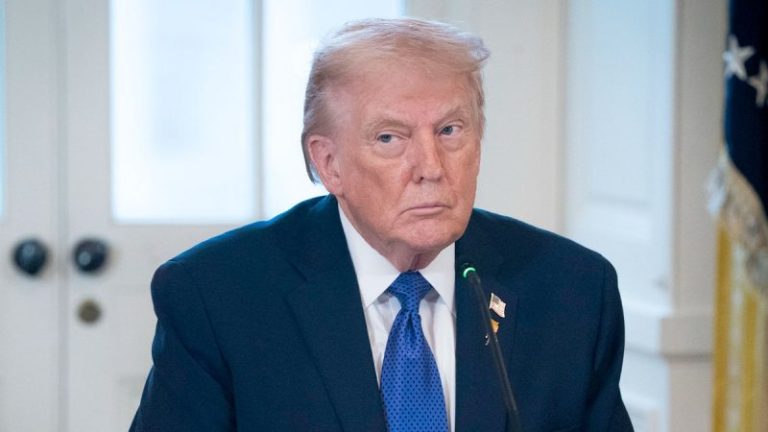
President Donald Trump announced Wednesday afternoon from the Oval Office that he learned the killing in Iran has ended. 

‘We’ve been told that the killing in Iran is stopping, and it’s stopped and stopping, and there’s no plan for executions or an execution,’ Trump said. ‘So, I’ve been told that on good authority. We’ll find out about.’

Trump made the announcement during a bill-signing ceremony in the Oval Office focused on ending an Obama-era policy barring public schools participating in the National School Lunch Program from offering whole and 2% milk to students.

Trump said he was informed by ‘very important sources on the other side, and they’ve said the killing is stopped. And the executions won’t take place.’ He did not divulge additional details. 

‘We’re going to watch and see what the process is. But we were given a very good, very good statement by people that are aware of what’s going on,’ Trump said when asked if military action was off the table considering the update. 

Iran’s citizens have taken to the streets in mass protests against Ayatollah Ali Khamenei’s regime in recent weeks, with reports claiming thousands of people have been killed as the regime cracks down on the protests. The protests come as the nation faces unrest over economic grievances and political repression. 

The U.S.-based Human Rights Activists News Agency announced that 1,847 of the dead were protesters and 135 were members of Iran’s security forces. Other reports say the death toll is more than 3,000 people, Fox News Digital previously reported. 

Iran’s judiciary had signaled a rapid crackdown, The Associated Press reported, with top judicial officials talking about fast-tracking trials for those arrested, a move that has raised alarms among rights groups about the risk of harsh sentences, including executions.

‘But that’s just gotten to me, some information, that the killing has stopped,’ Trump said. ‘That the executions have stopped and not going to have an execution, which a lot of people were talking about for the last couple of days. Today was going to be the day of execution.’

Trump and the administration have offered support to the protesters, including Trump calling on them to ‘take over’ the country’s institutions on Tuesday while canceling all meetings with the regime. 

‘I have canceled all meetings with Iranian Officials until the senseless killing of protesters STOPS. HELP IS ON ITS WAY,’ Trump posted to Truth Social Tuesday. 

The White House confirmed Monday that Trump was considering bombing Iran if the killings and unrest didn’t end, and White House press secretary Karoline Leavitt said diplomacy remains Trump’s first option.

Fox News Digital reached out to a spokesperson for the Islamic Republic of Iran’s permanent mission to the United Nations for additional comment but did not immediately receive a reply.

The protests are viewed as the most severe since 2022, when thousands took to the streets nationwide after the killing of a woman by the country’s morality police.

Fox News Digital’s Diana Stancy and Gregory Norman-Diamon contributed to this report. 

This post appeared first on FOX NEWS

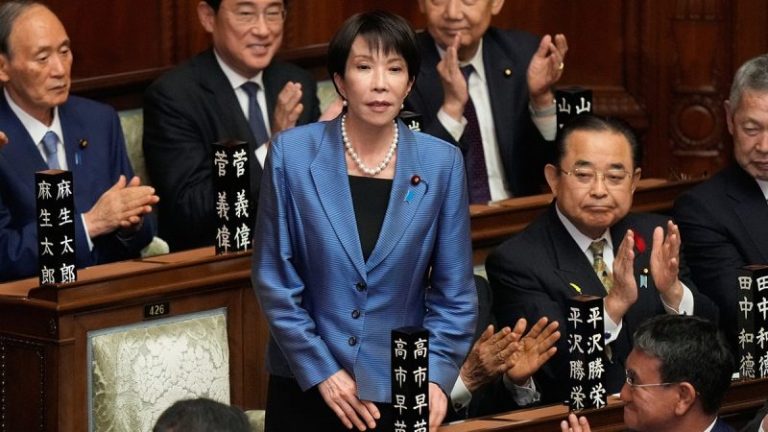
Japanese Prime Minister Sanae Takaichi plans to dissolve Parliament’s powerful lower house as early as this month, setting up a snap election aimed at securing voter backing for her agenda while her approval ratings remain high, a senior party official said.

The Associated Press reported that the move would allow Takaichi to seek fresh support for her economic and security priorities at a time when her scandal-tainted party and a new coalition partner hold only a slim majority in Japan’s legislature.

Takaichi made history in October when she was elected as Japan’s first female prime minister.

Described by some Japanese and international media as an ultraconservative, hard-line figure, Takaichi has backed strengthening Japan’s defense posture, emerged as a vocal China hawk and supported constitutional revisions to expand the role of the Self-Defense Forces.

Calling a snap election could allow Takaichi to capitalize on approval ratings of about 70% and help her Liberal Democratic Party gain additional seats in Parliament.

Shunichi Suzuki, secretary general of the ruling Liberal Democratic Party, told reporters that Takaichi informed him and other senior officials of her intention to dissolve the lower house ‘soon’ after it convenes Jan. 23.

Suzuki said no date has been set for dissolving the chamber or holding a snap election, adding that Takaichi plans to outline her strategy at a news conference Monday.

Takaichi’s scandal-tainted LDP and its coalition hold only a narrow majority in the lower house, Parliament’s more powerful chamber, after losses in the 2024 election.

By calling an early vote, Takaichi appears to be aiming to expand her party’s share of seats and strengthen its position alongside a new junior coalition partner.

Opposition lawmakers criticized the plan as self-serving, saying it would delay urgent parliamentary debate over the national budget, which must be approved quickly.

Echoing Suzuki’s comments, media reports have said Takaichi plans to dissolve the lower house on Jan. 23, the opening day of this year’s ordinary parliamentary session, potentially setting the stage for a snap election as early as Feb. 8.

Takaichi is seeking voter backing for her agenda, including ‘proactive’ fiscal spending and an accelerated military buildup under a new coalition with the Japan Innovation Party, Suzuki said.

The conservative Japan Innovation Party joined the ruling bloc after the centrist Komeito party withdrew, citing disagreements over Takaichi’s ideological positions and her approach to anti-corruption reforms.

Takaichi met Wednesday with Suzuki and other coalition leaders after holding talks in Nara with South Korean President Lee Jae Myung at a summit aimed at strengthening bilateral ties. The meetings came as she faces rising trade and political tensions with China following remarks on Taiwan that angered Beijing days after she took office.

Winning a snap election would also make it easier for Takaichi and her governing bloc to pass a budget and advance other legislation.

Her Cabinet approved a record 122.3 trillion yen ($770 billion) budget in late December that must clear Parliament before the fiscal year begins in April. The plan includes measures to fight inflation, support low-income households and boost economic growth.

Known for her hawkish and nationalistic views and her ultra-conservative positions on social issues, including gender and sexual diversity, Takaichi is seeking to reclaim conservative voters drawn to emerging populist parties in recent elections.

The Associated Press contributed to this report.

This post appeared first on FOX NEWS

Several federal prosecutors in Minnesota were formally fired on Wednesday after they gave notice that they had resigned in the wake of internal disagreements over the Justice Department’s handling of a shooting investigation involving Immigration and Customs Enforcement.

The DOJ, at the direction of Attorney General Pam Bondi and Deputy Attorney General Todd Blanche, terminated the employment of five prosecutors in the U.S. attorney’s office in Minnesota, including Joseph Thompson, the No. 2 official there,according to two sources familiar with the matter.

Their resignations and the internal disputes about the shooting probe first surfaced in the New York Times. The prosecutors were positioned to receive paid leave for months prior to their firings on Wednesday,according to the sources.

Thompson was spearheading a massive, high-profile investigation into welfare fraud in the state before he submitted his resignation. His exit came after he clashed with officials in Washington, D.C., over the investigation into the ICE shooting, which left 37-year-old Renee Good dead. Fox News Digital reached out to the U.S. Attorney’s Office in Minnesota in an effort to reach Thompson for comment.

Thompson had expressed during a call with DOJ and FBI officials last week that he was on board with investigating the ICE shooting as an assault on or obstruction of a law enforcement officer, a source familiar with the call told Fox News Digital.

Another one of the fired prosecutors, Melinda Williams, who was also involved in the fraud work, was on the call as well, the source said.

Thompson also indicated that he believed the shooting was justified, two sources said. Prior to the shooting, he had already been discussing the possibility of resigning, the sources said.

Videos of the shooting showed an ICE agent opening fire on Good at close range after she was seen accelerating toward the agent in her vehicle while he was standing in front of it. Critics have argued that the agent improperly used deadly force against Good and that she had turned the wheels of her vehicle away from the agent before accelerating.

The FBI is investigating the incident and has excluded Minnesota prosecutors from the probe, which the Trump administration has said is justified because the incident involved a federal officer. Minnesota leaders have denounced that decision and launched their own parallel investigation.

While supportive of conducting the investigation as an offensive against law enforcement — rather than a civil rights matter against the agent — Thompson had reservations during last week’s call about the DOJ’s plan to also investigate Good’s widow and other possible co-conspirators, the source familiar with the call said.

The FBI had developed evidence that suggested Good and her spouse had at some point been following ICE officers on the day of the shooting, the source said.

That revelation echoes Homeland Security Secretary Kristi Noem’s allegations during a recent press conference that Good had been ‘stalking and impeding’ ICE throughout the day of the shooting. Noem said Good ‘weaponized’ her vehicle and that the ICE agent who fired shots feared for his life.

In a statement to Minnesota Public Radio, Good’s spouse, Becca, said that on Jan. 7, the day of the shooting, she and Renee ‘stopped to support [their] neighbors.’

‘We had whistles. They had guns,’ Becca Good said.

Minneapolis Mayor Jacob Frey and other Democrats have lauded the prosecutors who resigned, framing their departures as a valiant boycott against DOJ.

‘These prosecutors are heroes, and the people pushing to prosecute Renee’s widow are monsters,’ Frey wrote on X.

At this stage, there is no sign that the DOJ is planning to bring charges against Becca Good, despite the DOJ and FBI pursuing an investigation into her as part of a broader probe into any conspiracies to hinder federal law enforcement operations.

Fox News Digital reached out to the DOJ for comment.

David Spunt contributed to this report.

This post appeared first on FOX NEWS